


As a supplier of rotavapor prices, I've witnessed firsthand the intricate relationship between a rotavapor's evaporation capacity per hour and its price. In the following blog, I'll delve into the factors that influence this relationship, providing insights for those in the market for a rotavapor.
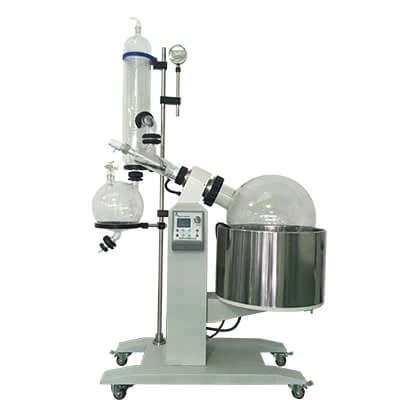

Understanding Evaporation Capacity
Evaporation capacity per hour is a crucial metric for rotavapors. It refers to the amount of solvent that a rotavapor can evaporate within an hour under specific conditions. This capacity is affected by various factors, including the size of the evaporation flask, the efficiency of the heating bath, the vacuum system, and the cooling capacity.
Factors Affecting Price Based on Evaporation Capacity
1. Size and Construction
Rotavapors with higher evaporation capacities typically require larger evaporation flasks and more robust construction. A larger flask can hold more solvent, allowing for a greater volume of evaporation per hour. However, larger flasks also require more substantial support structures and stronger rotation mechanisms to ensure stable operation. These additional components add to the manufacturing cost, which is reflected in the price.
For example, a rotavapor with a small evaporation capacity, suitable for laboratory-scale applications, may have a relatively simple design and smaller flask. In contrast, a high-capacity rotavapor designed for industrial use will have a larger flask, a more powerful motor, and a sturdier frame. The TOPTION Series Rotary Evaporators offer a range of evaporation capacities to meet different needs, with prices varying accordingly.
2. Heating and Cooling Systems
The heating and cooling systems are essential for efficient evaporation. A rotavapor with a higher evaporation capacity needs a more powerful heating bath to provide the necessary energy for vaporization. Additionally, a more effective cooling system is required to condense the vapor back into a liquid.
Advanced heating systems, such as those with precise temperature control and rapid heating capabilities, are more expensive to manufacture. Similarly, high-performance cooling systems, such as those using refrigerants or advanced heat exchangers, add to the cost. As a result, rotavapors with higher evaporation capacities, which demand more efficient heating and cooling, are generally priced higher.
3. Vacuum Systems
A good vacuum system is crucial for reducing the boiling point of the solvent and enhancing the evaporation rate. Rotavapors with higher evaporation capacities often require more powerful vacuum pumps to maintain a stable and low-pressure environment. These pumps are more expensive due to their higher performance and reliability.
Moreover, advanced vacuum control systems, which can adjust the vacuum level precisely according to the evaporation process, are also more costly. These features are necessary for high-capacity rotavapors to ensure efficient and consistent evaporation, contributing to the overall price increase.
Price Ranges for Different Evaporation Capacities
Low Evaporation Capacity (Less than 1L per hour)
Rotavapors with low evaporation capacities are commonly used in small laboratories or for research purposes where only a small amount of solvent needs to be evaporated. These rotavapors usually have a simple design and basic features, resulting in a relatively low price. They are suitable for applications such as sample preparation, small-scale distillation, and solvent recovery.
Medium Evaporation Capacity (1 - 5L per hour)
Medium-capacity rotavapors are more versatile and can be used in a wider range of applications, including medium-sized laboratories and some industrial processes. They offer a balance between performance and cost, with more advanced features such as better temperature control and more efficient vacuum systems compared to low-capacity models. The price of medium-capacity rotavapors is higher than that of low-capacity ones but still relatively affordable for many users.
High Evaporation Capacity (More than 5L per hour)
High-capacity rotavapors are designed for large-scale industrial production and heavy-duty applications. They require powerful heating, cooling, and vacuum systems, as well as robust construction to handle the high volume of evaporation. These rotavapors are equipped with advanced features and technologies, making them more expensive. For instance, the 10L Vacuum Rotary Evaporator, Customized Distilling Apparatus Rotary Evaporator Manufacturer and the 10L Rotary Evaporator New Design are examples of high-capacity rotavapors with advanced capabilities and corresponding higher prices.
Making the Right Choice
When choosing a rotavapor, it's important to consider your specific needs and budget. If you only need to evaporate a small amount of solvent, a low-capacity rotavapor may be sufficient. However, if you have large-scale production requirements or need to handle high volumes of solvent, investing in a high-capacity rotavapor is a better choice, despite the higher cost.
It's also advisable to compare different models and brands to find the best value for your money. Look for features such as reliability, ease of use, and after-sales service in addition to evaporation capacity and price.
Contact for Purchase and Negotiation
If you're interested in purchasing a rotavapor and would like to discuss the options further, please feel free to contact us. We have a team of experts who can provide you with detailed information and help you find the most suitable rotavapor for your needs. Whether you're a small laboratory or a large industrial enterprise, we're committed to offering high-quality products and excellent service.
References
- Smith, J. (2020). Principles of Rotary Evaporation. Journal of Laboratory Equipment, 15(2), 45 - 52.
- Johnson, A. (2019). Factors Affecting the Performance of Rotary Evaporators. Industrial Chemistry Review, 22(3), 78 - 85.