

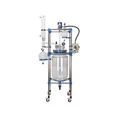

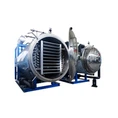
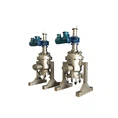

A high-pressure reactor is a sealed vessel engineered to conduct chemical reactions under extreme conditions (typically >10 MPa and >250°C). Unlike conventional reactors, its core innovation lies in magnetic coupling technology, which eliminates shaft seal leakage risks-a critical advancement for handling flammable, explosive, or toxic media (e.g., hydrogenation catalysts, corrosive acids).
Classification and Structure of High-Pressure Reactors
- High-pressure reactor designs vary widely to meet the needs of different operating conditions. They are categorized in various ways, the most intuitive of which is based on the heating method:
Electric heating: This is the most common heating method, using a heating jacket or furnace to heat the reactor externally, offering precise temperature control and convenient operation.
Jacket heating: This method uses a jacket placed outside the reactor body, allowing heating through a medium such as thermal oil or steam. It is suitable for reactions requiring rapid temperature increases or decreases.
Internal coil heating: A heating coil is installed inside the reactor, directly heating the reactants through the medium within the coil. This provides high thermal efficiency but increases the complexity of the reactor structure.
2. The core structure of a high-pressure reactor typically consists of the following key components:

The reactor body: As the primary pressure-bearing component, its material determines the pressure, temperature, and corrosion resistance that the equipment can withstand.
The lid: This seals the reactor body and typically integrates various interfaces, such as inlets and outlets, temperature probes, pressure gauges, and safety relief vents.
Stirring system: Ensures uniform mixing of reactants within the reactor. Includes a motor, magnetically coupled drive, and stirring blades.
Safety devices: Include pressure gauges, bursting discs, and safety valves to monitor and control reactor pressure and prevent overpressure.
Control system: Precisely controls and monitors reaction parameters such as temperature, pressure, and stirring speed.
Key distinctions from similar equipment
vs Autoclave: Autoclaves primarily sterilize via steam, operating at lower pressures (<3 MPa), while high-pressure reactors enable complex synthesis (e.g., polymerization) under 10–30 MPa.
vs Hydrothermal Reactors: Standard hydrothermal vessels (e.g., PTFE-lined) max out at 260°C/3 MPa, whereas specialized reactors (e.g., KCFD series) withstand 500°C/30 MPa for advanced material synthesis.
Analysis of key technical characteristics
Magnetic Coupling Drive
principle: Separates the motor (external) from the agitator (internal) via magnetic force, eliminating physical contact. This prevents seal degradation and media contamination.
Advantages:
Zero leakage: Essential for pharma-grade purity (e.g., API synthesis).
Explosion-proof: No spark risk in volatile environments (e.g., H₂ reactions).
Engineering Constraints:
Temperature limits: Neodymium magnets demagnetize above 250°C (THR series uses temperature-stabilized SmCo magnets for 300°C operation).

Material Selection and Safety
The safety of an autoclave reactor depends not only on precise structural design but also on careful material selection. The reactor body material must possess excellent mechanical strength, pressure resistance, high temperature resistance, and corrosion resistance.
Stainless steel (such as 316L): The most commonly used reactor body material, it offers excellent corrosion resistance and mechanical properties, making it suitable for most non-severely corrosive reactions.
Hastelloy and Monel: These specialty alloys offer excellent corrosion resistance and are particularly suitable for handling strong acids, strong bases, or media containing halogens.
Titanium alloy: Selected for certain specialized applications due to its high strength, lightweight, and excellent corrosion resistance.
In addition to the material, the safety features of the autoclave are also crucial.
Bursting disc: A passive safety device that instantly ruptures when the pressure inside the reactor reaches a set value, rapidly releasing pressure and preventing the reactor from exploding.
Safety valve: An active safety device that automatically opens to release pressure when the pressure inside the reactor exceeds a set value and then automatically closes again when the pressure returns to normal.
Temperature and pressure sensors: Real-time monitoring of parameters in the reactor. Once the parameters exceed the set range, the control system will automatically take measures (such as stopping heating, cooling, etc.) to ensure that the reaction proceeds within a controllable range.
Corrosion-resistant material matrix
| Material | Max Temp | Corrosion Resistance | Use Cases |
|---|---|---|---|
| SS316L | 400°C | Moderate acids, alkalis | Standard pharmaceutical use |
| Hastelloy C-276 | 400°C | Concentrated HCl/H₂SO₄ | Acid catalysis |
| Titanium | 300°C | Chloride media, seawater | Offshore R&D |
| Liner Options: PTFE (180°C) for general use; PPL (260°C) for high-temperature hydrolysis (per ISO 3696). |
Pressure and temperature limits
Standard Series: THR/MHR (10 MPa, 250–300°C)
Custom Series: GSH/KCFD (30 MPa, 500°C) with internal cooling coils for rapid quenching.
1. Comparison of mainstream product series
| Parameter | THR Series | MHR Series | GSH Custom |
|---|---|---|---|
| Agitation | Bottom magnetic stirrer | Top-coupled motor drive | Configurable |
| Media Suitability | Non-magnetic, low-viscosity | High-viscosity/magnetic particles | Extreme conditions |
| Safety Notes | Avoid >250°C (demagnetization) | No magnetic decay below 300°C | 30 MPa burst disc |
Selection criteria:
For nano-catalyst testing (e.g., Pd/C hydrogenation), choose MHR with Hastelloy body to resist H₂S corrosion.
For polymer synthesis (e.g., nylon-6,6), select THR with PTFE liner to prevent monomer adhesion.
2. Core application scenario cases
Pharmaceutical Synthesis:
MHR-100 reactors enable tamoxifen precursor synthesis at 8 MPa H₂, utilizing magnetic coupling to prevent O₂ ingress. Yield purity: >99.8% (USP Grade).
Nanomaterial Synthesis:
Hydrothermal quantum dot production in PPL-lined reactors (260°C, 10 MPa), achieving particle uniformity of ±2 nm.
Catalyst Screening:
Hastelloy GSH reactors sustain 20 MPa/450°C during Fischer-Tropsch trials, with corrosion rates <0.01 mm/year.
3. Safety design and operation specifications
Explosion-proof mechanism:12.5 MPa rupture discs (ASME Section VIII compliant), auto-vent upon overpressure.
Risk of demagnetization: THR reactors are hard-capped at 250°C-exceeding this degrades magnetic stirrers irreversibly.
Critical Protocols:
Never disassemble under pressure (risk: explosive decompression, as in the 2023 BASF incident).
For Cl⁻ media, specify titanium liners-SS316L corrodes 100× faster at >80°C.
Electropolished interiors reduce particulate contamination in GMP applications.
4. Conclusion: Selection Decision Framework
Follow this 4-step methodology:
Define parameters: Pressure (e.g., >15 MPa → GSH series), temperature, volume (50ml–50L).
Select materials: Match media corrosivity (HCl → Hastelloy; NaOH → SS316L).
Agitation type: High-viscosity polymers → MHR's top-drive; non-Newtonian fluids → THR's bottom stirrer.
Verify safety: Require third-party ASME/CE certifications + cooling coil options for exothermic reactions.
Industry Trends: Miniaturization (bench-top reactors for lab-scale R&D) and IoT integration (real-time pressure/temperature analytics).
FAQ Integration
Q1: Can reactors use steam/oil heating instead of electricity?
A1: Yes. Steam heating requires specifying jacket pressure ratings; oil circulation needs thermal fluid ports.
Q2: What data is needed for custom reactors (GSH series)?
A2: Volume, working pressure/temperature, agitation type, material compatibility (e.g., HCl concentration), and safety certifications.
Q3: Why avoid flange-sealed mini reactors?
A3: Small vessels (<500ml) sacrifice heating uniformity and port accessibility with flange systems-threaded seals are optimal.
Final hook: 83% of reactor failures stem from material mismatch. Download our Corrosion Resistance Matrix to specify with confidence.
Q4: The standard autoclave is electrically heated. Can it be heated with circulating oil or steam?
A4: Yes. If steam heating is required, the customer must provide the steam pressure parameters.
Q5: When customizing an autoclave, what information do customers need to confirm?
A5: Primarily, we need to confirm the equipment's volume, operating pressure, operating temperature, stirring method, and other special requirements.
Q6: Is the autoclave's motor torque adjustable?
A6: No.
Q7: Does the THR-100 micro autoclave have a burst valve?
A7: It does not come standard with a burst valve.
Q8: What material is the gasket for the solids feed port of the autoclave made of?
A8: Metal gaskets are normally delivered to customers.
Q9: The set temperature of the THR series autoclave differs significantly from the actual temperature. How can I resolve this issue?
A9: You need to enable the operating temperature auto-tuning function. Performing two or three operating temperature auto-tuning cycles will resolve the issue.
Watch More!