

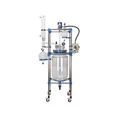

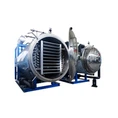
In the world of turning liquids into solid powders, spray drying and freeze-drying are undoubtedly two important "contenders." Each possesses a unique "set of skills" suitable for different "battlefields" and "opponents." Let's deeply understand the characteristics and advantages and disadvantages of these two "contenders."

Different Principles: A Contest of Speed and Gentleness
Spray Drying: A Fast-Paced "Hothead"
Imagine spraying liquid raw materials like a fine rain into hot air, where the moisture evaporates instantly, leaving behind dry solid particles. This is the basic principle of spray drying. Its core lies in rapid evaporation.
1. Atomization: The liquid raw material is dispersed into fine droplets through nozzles or rotary atomizers, increasing the contact area with the hot air.
2. Drying: The droplets rapidly come into contact with the hot drying medium (usually hot air), and the moisture quickly vaporizes.
3. Separation: The dried solid particles are separated from the gas stream, usually through cyclone separators or bag filters.

Freeze-Drying (Lyophilization): A Gentle, Slow-Paced Method
In contrast to the "vigorous and rapid" spray drying, freeze-drying appears "gentle and meticulous." It removes moisture through sublimation, maximizing the preservation of the material's original properties.
1. Freezing: The liquid raw material is frozen into a solid ice at low temperatures.
2. Vacuum: A high vacuum environment is applied to the frozen material.
3. Sublimation: Under vacuum and appropriate heating conditions, the solid ice directly transforms into gaseous water vapor without passing through the liquid phase.
4. Desorption: Residual bound water is removed to further reduce the moisture content of the material.

Equipment Overview: Considerations of Structure and Cost
• Spray Dryer: The structure is relatively simple, mainly including a feeding system, atomizer, drying tower, hot air system, and separation and collection system. According to the atomization method, common types include centrifugal, pressure, and pneumatic spray dryers. Its production capacity is usually high, allowing for continuous production. The equipment cost is relatively low, but energy consumption is high.
• Freeze Dryer: The structure is relatively complex, mainly including a refrigeration system, vacuum system, heating system, and control system. According to the processing method, there are various types such as tray, multi-belt, and vial freeze dryers. Its production cycle is longer, and the production capacity is relatively low, belonging to batch or semi-continuous production. The equipment cost is high, but energy consumption is relatively low.
Product Characteristics: Differences in Flavor, Solubility, and Morphology
• Spray-Dried Products:
Morphology: Usually fine spherical or near-spherical particles with good flowability, easy to package and disperse.
Solubility: Due to the high-temperature process, some heat-sensitive components may be lost or denatured, affecting the product's solubility. However, by optimizing process parameters, products with good instant solubility can be obtained.
Flavor and Aroma: High temperatures may lead to the loss of some volatile flavor compounds.
Density: Usually has a higher bulk density.
• Freeze-Dried Products:
Morphology: The product is loose and porous, with a sponge-like or cake-like structure.
Solubility: Due to drying under low temperature and vacuum conditions, the original structure and active ingredients of the material are maximally preserved, so it usually has excellent rehydration and solubility.
Flavor and Aroma: Low-temperature drying can maximize the preservation of the material's original flavor, aroma, and nutritional components.
Density: Usually has a lower bulk density.
Application Fields: Each Has Its Strengths, Complementing Each Other
Typical Applications of Spray Drying:
Food Industry: Milk powder, coffee, fruit juice powder, seasonings, plant extracts, etc.
Pharmaceutical Industry: Active pharmaceutical ingredients, excipients, vaccines, etc.
Chemical Industry: Dyes, pigments, catalysts, ceramic powders, etc.

Typical Applications of Freeze-Drying:
Food Industry: High-end foods (such as freeze-dried coffee, freeze-dried fruits, freeze-dried vegetables), biological products (such as probiotics, enzyme preparations), etc.
Pharmaceutical Industry: Biological preparations (such as vaccines, antibiotics, blood products), diagnostic reagents, etc.
Biotechnology: Cells, tissues, proteins, etc.

Comparison of Advantages and Disadvantages: A Clear Choice
To better understand the differences between the two, let's summarize them in a table:
| Feature | Spray Drying | Freeze-Drying |
| Drying Principle | High-temperature rapid evaporation | Low-temperature sublimation |
| Drying Temperature | Higher | Lower |
| Drying Time | Short | Long |
| Product Morphology | Fine spherical or near-spherical particles, good flowability | Loose and porous, sponge-like or cake-like structure |
| Solubility | May be affected by heat, but instant solubility can be improved by process optimization | Excellent, good rehydration |
| Flavor & Aroma | Possible partial loss | Maximum preservation |
| Nutritional Content | Heat-sensitive components may be lost | Maximum preservation |
| Bulk Density | Higher | Lower |
| Equipment Cost | Lower | Higher |
| Operating Cost | Higher energy consumption | Relatively lower energy consumption |
| Production Capacity | High, can be continuous production | Low, usually batch or semi-continuous production |
| Applicable Materials | Suitable for most pumpable liquid materials | Suitable for heat-sensitive, easily oxidized materials, and products requiring high rehydration |
| Typical Applications | Milk powder, coffee, seasonings, active pharmaceutical ingredients, chemical powders, etc. | Freeze-dried food, biological preparations, vaccines, diagnostic reagents, etc. |
How to Choose? It Depends on Your Needs!
The choice between spray drying and freeze-drying depends critically on your specific needs and the characteristics of the material:
• If your material is not heat-sensitive, requires large-scale production, and the rehydration properties of the product are not critical, then spray drying may be a more economical and efficient choice.
• If your material is heat-sensitive, requires maximum preservation of its bioactivity, flavor, aroma, and color, and the rehydration properties of the product are very important, then freeze-drying is undoubtedly the better choice, although its cost and production cycle will be higher.
Of course, in practical applications, the two technologies are sometimes combined, for example, using spray drying for initial dehydration followed by freeze-drying for further drying to obtain better product quality and efficiency.
Hopefully, this detailed comparison can help you better understand the characteristics of spray drying and freeze-drying and provide some reference for your choices. If you have any other questions, feel free to ask!