

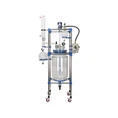

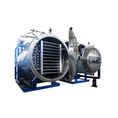
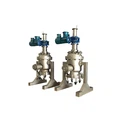
Introduction
Some manufacturers of silicone oils, for a variety of purity and application needs, might require less residual low-molecular-weight siloxanes. Cyclic siloxanes, like D4, D5, and D6, may require some attention in such a case. However, removing these siloxanes from silicone fluids is not as simple as applying heat. Feed viscosity, volatility differences, process pressure, thermal exposures, vapor condensations and product recoveries all impact the separation process.
Wiped film evaporation and short path distillation are the two technologies that deserve further consideration. Although both are based on the same evaporative principles, the configuration of the two technologies and the placement of the condensers are quite different. The determination to use a wiped film evaporator (PWFS), a short path distillation system (MDS), or both depends on the nature of the actual feed material and the requirements of the finished product.
TOPTION provides wiped film evaporators and short path distillation systems for use in laboratory, pilot, and large-scale unit operations. The company also provides customer material testing, process design, and customized engineering, as well as installation, commissioning, and training services. This guide explains the engineering considerations, process options, equipment selection factors, and pilot testing approach for silicone oil devolatilization.
1. Understanding D4, D5, and D6 in Silicone Oil
What Are Low-Molecular-Weight Cyclic Siloxanes?
D4, D5, and D6 are cyclic siloxanes containing repeating silicon-oxygen structures. Their chemical names are:
- D4: Octamethylcyclotetrasiloxane
- D5: Decamethylcyclopentasiloxane
- D6: Dodecamethylcyclohexasiloxane
These compounds differ in their molecular structures and physical properties. Their volatility characteristics are relevant when developing a separation process. Depending on the silicone oil formulation, manufacturing process, and product requirements, residual cyclic siloxanes may need to be reduced during purification or finishing.
Why Is Low-Molecular-Weight Siloxane Removal Important?
The required residual concentration depends on the intended application and the customer's product specification.
- Residual volatile content.
- Individual D4, D5, and D6 concentrations.
- Product consistency and quality requirements.
- Material recovery during processing.
- Analytical verification of the finished silicone fluid.
There is not a generic level of concern for residual siloxanes in silicone oils. The feedstock composition and specified product requirements will determine the appropriate level of concern for volatile removal.
2. Engineering Challenges for the Devolatilization of Silicone Oils
Feed Viscosity and Film Distribution
The viscosity of the feed material influences the distribution of the feed film and determines the type of pump which is used to transfer the feed. A wiped film evaporator maintains consistent evaporation conditions over the entire surface by distributing the feed material across the evaporation surface. The type of equipment and configurations used for the distribution of the feed material must be assessed using the true viscosity of the feed material rather than assuming the viscosity of all silicone oils.
Temperatures and Thermal Exposures
Generally, it is necessary to adjust the operating temperature of the evaporator and increase the residence time of the feed material to remove the low molecular weight components from the feed. It is essential that these conditions be integrated. The increased operating temperature of the evaporator may lead to the decomposition of certain components, which can adversely affect the final product. Thin film evaporation allows for the exposure of a relatively thin layer of material to a heated surface. The appropriate process conditions (i.e. temperature and residence time) must be determined during process testing.
Vacuum and Vapor Condensation
Vacuum operation allows the evaporation of volatile constituents at the process temperature.
Achieving a vacuum, however, does not ensure successful component separation.
The entire system must address:
-
Process pressure and operating conditions.
-
Loading of the vapors.
-
Condensation.
-
Cooling.
-
Vacuum system performance.
-
Collection of the volatile fraction.
These must be considered to design and build a high-vacuum silicone devolatilization system.
Separation Selectivity and Product Recovery
D4, D5, and D6 may not act equally during evaporation. The separation of these components is dependent on volatility, process conditions, and the performance of the equipment. A suitable process should assess residual siloxane levels, product recovery, and the effect of the process on treated silicone oil.
3. Wiped Film Evaporator for Silicone Fluid Devolatilization

A wiped film evaporator employs a mechanical mechanism for distributing a process fluid across a heated cylindrical surface.
This concept is suitable for processes where the formation of a thin film of a material is required along with continuous movement of the material.
How does a Wiped Film Evaporator Work?
A wiped film evaporation process consists of the following steps:
- Feed material: The evaporator is supplied with the process material.
- Film Distribution: The incoming process material forms a thin film on the surface of the heated evaporation section.
- Mechanical wiping: Rotating blades continuously renew and evenly distribute the material film.
- Evaporation: Volatile components of the charge evaporate at the operating conditions.
- Vapor condensation: Vapor generated is condensed in a suitable system.
- Product discharge: The remaining liquid is discharged through a product discharge arrangement.
Why Consider Thin Film Evaporation?
Wiped film technology is worth evaluating for the following process characteristics for silicone oil processing:
- Continuous renewal of the film (providing more uniform evaporation)
- Control of the contact area with the evaporation surface
- Processing of viscous materials (capability to process high-viscosity materials)
- Possibility of continuous feeding and discharging
- Integration of vacuum and condensation systems
Taken together, these characteristics make wiped film evaporators a reasonable option for silicone fluid devolatilization.
However, the actual performance for the removal of D4/D5/D6 requires testing with the customer's feed material.
When Should Manufacturers Consider a PWFS System?
A wiped film evaporator may be used when the process requires:
- Evaporation of heat-sensitive materials.
- Continuous processing of materials.
- Thin-film evaporation.
- Evaluation of the removal of volatile components.
- Pilot scale testing.
- Custom design based on raw materials.
The final decision is dependent on the viscosity, the feed rate, the required evaporation, and the product specifications.
4. Short Path Distillation for Silicone Polymer Purification

How Does Short Path Distillation Work?
It consists of the following steps:
- Feeding the material to be distilled into the evaporator.
- Even distribution of the material to a thin film.
- Controlled vacuum heating.
- Evaporation of more volatile components.
- Transportation of the vapor by a short path to the internal condenser.
- Collection of the light distillate (the more volatile components) and the heavy residuum.
The major innovation in short path distillation equipment is the use of a short path (distance) for the transport of vapors.
Potential Benefits for Silicone Oil Devolatilization
Short path distillation is a technique that is worth considering if:
- There is a need to evaporate a component with a high boiling point by the use of a vacuum.
- The distance through which the vapor has to travel to a condenser is to be kept as short as possible.
- The vapor needs to condense internally.
- It is required to remove volatile component of a less volatile component.
- It is required to process a heat sensitive material under controlled conditions.
For D4/D5/D6 removal, the actual separation depends on the balance of feed composition, process conditions, and condensation temperature.
Therefore, the viability of an MDS system for a given silicone oil must be tested.
Wiped Film Evaporation vs. Short Path Distillation
|
Consideration |
Wiped Film Evaporator |
Short Path Distillation |
|
Main principle |
Thin-film evaporation |
Thin-film evaporation with short vapor path |
|
Film formation |
Mechanical wiping |
Thin-film evaporation structure |
|
Vapor condensation |
External condenser arrangement |
Internal condenser arrangement |
|
Main engineering focus |
Film distribution and evaporation |
Evaporation and short-distance condensation |
|
Selection factors |
Viscosity, throughput, process conditions |
Volatility, vacuum, condensation and product requirements |
The two technologies share some operating principles but should not be treated as identical equipment configurations. Importantly, short path distillation systems can also use wiped-film or thin-film evaporation structures. The selection should be based on the actual separation requirements, not simply on the equipment name.
5. Proposed Silicone Oil Devolatilization Process
The process configuration should be based on the feed material, the desired concentration of residual siloxane, and the processing requirement.
A single-stage wiped film evaporator, a short path distillation system, or a combination of both, could be used.
Conceptual Process Flow
|
Stage |
Process unit |
Purpose |
|
1 |
Raw Silicone Oil Feed Tank |
Feed storage and material characterization |
|
2 |
Feed Pump and Preheating System |
Controlled material feeding and temperature conditioning |
|
3 |
Wiped Film Evaporator (PWFS) |
Optional initial devolatilization stage |
|
4 |
Short Path Distillation (MDS) |
Optional further separation stage |
|
5 |
Purified Silicone Oil Collection |
Product sampling and quality verification |
Associated process systems may include a vacuum system, condenser, cold trap, light-fraction receiver, temperature control, and pressure instrumentation. Actual equipment connections and process sequence require engineering confirmation.
Key Instrumentation and Monitoring Points
A process flow diagram should show the important instrumentation and process controls such as:
- Feed flow meter and pump control.
- Evaporator temperature.
- Process vacuum.
- Condenser temperature.
- Heating and cooling system controls.
- Light fraction and product discharge.
- Sampling points of feed and finished product.
Other instrumentation will depend on the equipment configuration and the requirements of the project.
Should a Single- or Two-Stage Process be Used?
There is no particular configuration for every single silicone oil formulation. Three process options are available:
Option 1: Wiped Film Evaporation
A PWFS system is evaluated as the primary evaporation unit when its film formation, operating conditions, and separation performance satisfy the required process objectives.
Option 2: Short Path Distillation
An MDS system is evaluated when short-path evaporation and internal condensation are appropriate for the material and target separation.
Option 3: Combined Wiped Film Evaporation and Short Path Distillation
A two-stage arrangement may be considered when testing indicates that separate evaporation and further fractionation stages are beneficial.
The combined configuration should only be recommended when supported by material testing and process calculations. Adding a second unit does not automatically guarantee better D4/D5/D6 removal.
6. Evaporation Area Calculation and Equipment Sizing
Correct equipment sizing is critical when designing a silicone oil devolatilization system. The required evaporation area is a function of the amount of material to be evaporated, the properties of the feed, and the performance of the evaporation system established during testing.
Parameters Required for Calculation
|
Parameter |
Symbol |
Unit |
|
Feed flow rate |
F |
kg/h |
|
Volatile removal rate |
ṁv |
kg/h |
|
Evaporation flux |
J |
kg/m²·h |
|
Required evaporation area |
A |
m² |
|
Feed viscosity |
μ |
cSt or mPa·s |
|
Operating pressure |
P |
Pa |
Basic Evaporation Area Formula
A = ṁv / J
Where A is the required evaporation area, ṁv is the required evaporation rate, and J is the validated evaporation flux.
For example, if the measured evaporation rate is established through testing, and a reliable evaporation flux is available under comparable operating conditions, the formula can provide a preliminary area estimate. However, neither the evaporation rate nor evaporation flux should be assumed without supporting process data.
For low-concentration D4/D5/D6 removal, the target-component removal rate must also be distinguished from the total vapor load. These are not necessarily the same quantity.
Factors affecting Equipment Size
The final equipment selection should account for:
- Viscosity of the silicone oil.
- Concentration of the initial volatiles.
- Concentration of residual D4/D5/D6.
- Operating temperature and vacuum.
- Evaporation flux.
- Recovery of the product.
- The capacity of the condenser and vacuum system.
- Continuous operation.
Pilot testing is critical prior to the finalization of the area of the evaporators to be used in industry.
7. TOPTION Equipment Selection for Silicone Oil Processing
TOPTION offers wiped film evaporator and short path distillation systems covering different evaporation areas and processing capacities. These equipment families provide potential options for laboratory development, pilot testing, and industrial process evaluation.
The following specifications are presented as general equipment specifications from the respective product pages. They are not demonstrated silicone-oil-specific processing results.
7.1 Pilot-Scale Short Path Distillation: MDS-20CE, MDS-30CE and MDS-50CE
|
Model |
Evaporation area |
Published processing capacity |
|
MDS-20CE |
0.2 m² |
6–20 L/h |
|
MDS-30CE |
0.3 m² |
10–30 L/h |
|
MDS-50CE |
0.5 m² |
10–50 L/h |

7.2 Industrial Short Path Distillation: MDS 1 – 10 m² Series
For larger processing requirements, TOPTION provides industrial MDS short path distillation systems.
- Evaporation area: 1 – 10 m²
- Process capacities of 30 to 1,000 L/h (depending on the model)
- High precision gear pump feeding and product discharge.
- Pipelines with thermally fluid jacket.
- Standard or optional explosion proof control cabinets.
- SS304 is the standard material for this product series.
Vacuum specifications vary by model. For example, the published MDS-100CE specification lists 0.05 Pa, while the MDS-200CE and MDS-500CE list 0.1 Pa. The complete model specification should be checked before selecting an industrial configuration.

7.3 Compact and Pilot Wiped Film Evaporators: PWFS-0.1 to PWFS-0.5
|
Model |
Evaporation area |
Published actual processing capacity |
|
PWFS-0.1 |
0.1 m² |
2–10 L/h |
|
PWFS-0.2 |
0.2 m² |
10–20 L/h |
|
PWFS-0.3 |
0.3 m² |
15–30 L/h |
|
PWFS-0.5 |
0.5 m² |
Confirm model-specific specification |
It also describes A/B/C feed and discharge configurations, continuous feeding options, customized vacuum, heating and collection configurations, and different feed tank arrangements. This series may be considered for preliminary material evaluation and wiped film process development.

7.4 Pilot-to-Production Wiped Film Evaporators (PWFS-1 to PWFS-3)
|
Model |
Evaporation area |
Published actual processing capacity |
|
PWFS-1 |
1 m² |
50–100 L/h |
|
PWFS-2 |
2 m² |
100–200 L/h |
|
PWFS-3 |
3 m² |
100–300 L/h |
Includes product-contact material S31603, frame and non-contact structure S30408, continuous feeding and discharge, and integration options for feed tanks, preheaters, condensers, vacuum systems, collection vessels, and controls. The system configuration can be customized according to project requirements.

Equipment Selection Comparison
|
Equipment family |
Evaporation area |
Published capacity range |
Main application stage |
|
MDS Pilot |
0.2–0.5 m² |
6–50 L/h |
Pilot testing |
|
MDS Industrial |
1–10 m² |
30–1,000 L/h |
Industrial processing |
|
PWFS Compact/Pilot |
0.1–0.5 m² |
Model-specific |
Material testing and pilot development |
|
PWFS Pilot-to-Production |
1–3 m² |
50–300 L/h |
Scale-up and production |
8. Pilot Testing and Customized Process Development
There are several aspects to consider when determining the viability of a process configuration, based on silicone oil evaporation area or published processing capacity alone may not be sufficient. In some cases, pilot testing provides the opportunity to gain first-hand experience on the behavior of the material of interest before investing in larger-scale units. At TOPTION, we support customer material testing and work with them in the development of a customized process.
Step 1: Feed Material Assessment
The first step is to understand the feed material being processed. This includes, but is not limited to, type of silicone oil, chemical composition, feed viscosity, D4, D5, D6 concentrations, total volatile content, evaporation area, and the type of product required.
Step 2: Pilot Plant Evaluation
The next step is to evaluate the proposed configuration at the pilot plant level. Various aspects of the design may be evaluated including feed rate, operating temperature, vacuum level, the conditions of the condenser, the rate of evaporation, and the recovery of the product. The goal of this testing is to evaluate the behavior of the material at the process conditions of interest.
Step 3: Analytical Verification
The performance of the separation is determined by analyzing the feed and the treated product. Depending on the analytical requirements, GC-MS or GC-FID may be considered for determination of individual cyclic siloxanes.
- Initial concentrations of D4, D5, and D6 are to be determined.
- Residual concentrations of D4, D5, and D6 are to be determined.
- Total volatile content is to be determined.
- Product recovery is to be determined.
- Relevant product properties are to be determined.
Testing shall be performed to determine target compounds. Appropriate methods are to be used for calibration and sample preparation. Detection limits of the methods and equipment shall be determined.
Step 4: Selection of Industrial Equipment
Pilot tests serve to evaluate the required evaporation surface area, the appropriate PWFS or MDS model, the demand on the vacuum system, the heating and cooling capacity, the arrangement of condensation, as well as collection and discharge of the condensate. Furthermore, the tests assess the degree of process automation and continuous production.
Following the pilot test, TOPTION can construct a specific equipment configuration based on the customer's material and production requirements.
9. Frequently Asked Questions About Silicone Oil Devolatilization
1. How Can D4, D5, and D6 Be Removed from Silicone Oil?
Wiped-film evaporation and short-path distillation can be evaluated to remove low-molecular-weight siloxanes. The process chosen can be dependent on the feed composition, viscosity, process operating conditions, and the desired residual concentration. Actual removal performance must be validated by testing.
2. Can a Wiped Film Evaporator Remove Low-Molecular-Weight Siloxanes?
A wiped-film evaporator can provide thin-film evaporation, which can be dependent on the operating conditions of the system, the volatility of the material to be removed, and the system condensation. Performance must be tested to verify removal.
3. Is Short Path Distillation Suitable for Silicone Oil Purification?
Short path distillation can be considered for the purification of silicone oil, depending on the requirements for the purification of the oil and the operating conditions of the system. Representative feed material and analysis must be provided to evaluate performance.
4. How Do You Determine the Required Evaporation Area?
The evaporation area can be estimated, based on the required evaporation rate, validated evaporation flux, and other process variables, like feed viscosity, process pressure and temperature, and evaporation ratio. Performance of the process must be tested to validate the process data required for equipment design.
5. Can TOPTION Perform Pilot Testing of Silicone Oil Processing?
Yes. TOPTION performs customer material testing and process design. Based on the characteristics of customer material and product specifications, TOPTION can evaluate suitable wiped film evaporators and short path distillation systems. The company also performs equipment installation, commissioning and operating personnel training.
10. Describe Your Silicone Oil Devolatilization Project to TOPTION
Low-molecular-weight siloxanes devolatilization of silicone oils requires a process defined by the characteristics of customer material and product specifications. TOPTION manufactures and sells wiped film evaporators and short path distillation systems for laboratory, pilot-plant and large-scale production. Depending on the requirements of your process, our team can determine the needed configuration of PWFS and/or MDS systems.
Based on your material characteristics, desired D4/D5/D6 concentration levels and the production volume to be processed, contact our engineering team. TOPTION performs customer material testing and process design, equipment installation, commissioning and personnel training.
Wiped Film Evaporators | Vacuum equipment for R&D