

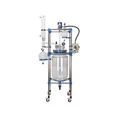



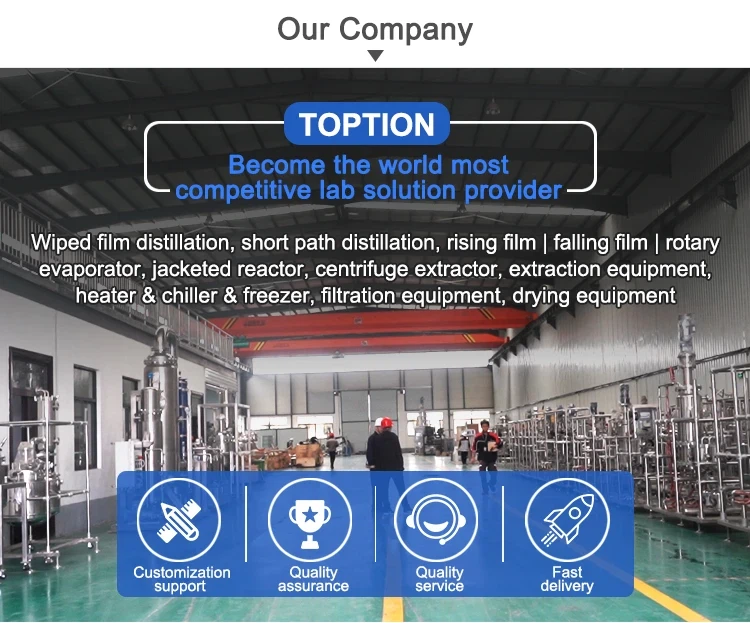
Xi'an TOPTION Instrument Co., Ltd. is one of the most reliable manufacturers and suppliers of glass reactor filter for solid-liquid separation in China. We provide high quality solutions & products for global customers who work in chemistry, biology, pharmaceutical, food, etc. If you have any enquiry about lab solution customization, please feel free to email us.
Description
In the fast-paced world of chemicals and pharmaceuticals, achieving high efficiency and accuracy is crucial for staying ahead.
The development of glass reactor filters has revolutionized laboratory and industrial processes by merging reaction and filtration capabilities into a single, cutting-edge device. By consolidating multiple stages, including chemical synthesis, crystallization, separation, and product recovery, these filters simplify workflows, reduce waste, and lower the risk of contamination. Our premium glass reactor filters offer unparalleled reliability and performance, providing a convenient, safe, and efficient all-in-one solution for scientists and production teams.

Glass Reactor Filter setup
|
Model |
Configuration instructions |
Quantity |
|
TOPT-5L |
Reactor kettle body:5L |
1 Set |
|
Reactor kettle cover:φ180mm; Kettle cover open: (stirring port), (Evaporation port),(Temp port), (Liquid feed port),(Drip port) |
1 Set |
|
|
Stir bar:φ10mm; |
1 Set |
|
|
Condenser; |
1 Set |
|
|
Thermometer tube; |
1 Set |
|
|
Liquid feed valve; |
1 Set |
|
|
Constant voltage funnel; |
1 Set |
|
|
Motor:60(0.95Nm); |
1 Set |
|
|
speed controller:50-600rpm; |
1 Set |
|
|
Discharge valve; |
1 Set |
|
|
Full set of stents: 1 set |
1 Set |
Advantages of Glass Reactor Filters
Glass reactor filters with a versatile "one-pot" design bring about various advantages, enhancing efficiency, safety, and the quality of the final product.
Enhanced Efficiency through Simplified Processes:
By carrying out various stages such as reaction, crystallization, solid-liquid separation, and washing in a single vessel, the process becomes more efficient as it eliminates the necessity for material transfer. This results in time savings and a streamlined process flow.
Enhanced Product Quality and Recovery:
By minimizing the number of material transfers, the risk of contamination and product loss is significantly reduced, resulting in higher purity and yield of the final product, particularly when working with valuable or sensitive materials.
Advanced Thermal Regulation:
The jacketed configuration creates a self-contained space for fluid temperature manipulation, allowing for accurate and consistent temperature management. This level of control is especially crucial during crystallization processes, as it enables the precise regulation of crystal shape and dimensions.
Features
1. Our 80~1 20um sand core filtration system combines filtration and reaction in a single unit, streamlining the process and reducing the need for additional filtering steps, resulting in time and cost savings.


2. Our system boasts a spacious double-layer condenser, guaranteeing exceptional efficiency during vaporization and reflux processes. This innovative design optimizes condensation capability, thereby enhancing output and recovery.
3. Superlative corrosion resistance. All components are built entirely from borosilicate 3.3 glass, providing excellent chemical and physical stability.


4. Anchor-style PTFE impeller on a steel-reinforced shaft. Engineered for effective mixing across a broad viscosity spectrum.
5. Full-drainage bottom valve. Its zero dead-space design prevents material accumulation and ensures complete mixing within the vessel.


6. Broadly customizable reactor solution. Flexible configuration with a volume range of 500 mL to 200 L.
Applications
Chemical synthesis
Chemical synthesis refers to the process of mixing two or more chemical substances and producing new chemical substances through chemical reactions. Reactors are widely used in chemical synthesis and can be used to prepare various organic compounds, pharmaceuticals, fertilizers, and more. By controlling parameters such as temperature, pressure, and reaction time within the reactor, the reaction rate and product quality can be controlled.
Polymerization
Polymerization is the process of combining monomer molecules into polymer compounds through chemical reactions. Reactors can be used to produce various polymer materials, such as polyethylene, polypropylene, and polyurethane. In polymerization reactions, parameters such as reactor temperature and stirring speed have a significant impact on the reaction outcome, and therefore require precise control to obtain the desired polymer product.
Catalytic reaction
A catalytic reaction occurs when a chemical reaction is carried out at relatively low temperatures and pressures under the action of a catalyst. Reactors can be used to prepare various catalysts, such as precious metal catalysts and solid acid catalysts. Catalytic reactions offer advantages such as fast reaction rates, mild reaction conditions, and high product purity, and are therefore widely used in the chemical industry.
Service and Support
Tailored Solutions:
Our skilled team of engineers, boasting 18 years of experience, specializes in creating customized designs to cater to your unique experimental requirements. We offer the flexibility to customize capacities, lid opening setups, and impeller materials like SS316 or titanium to ensure seamless integration with your processes.
Comprehensive On-Site Support:
To guarantee seamless integration and optimal performance of our larger or more intricate systems, we provide personalized on-site installation services and expert training for your staff, ensuring a safe and productive working environment.
After-Sales Service:
We offer thorough after-sales assistance, including a well-stocked supply of spare parts and consumables, to quickly address any immediate requirements and maintain smooth R&D or production operations without interruptions.
Expert Process Enhancement:
Our team of engineers can analyze your process flowchart and recommend the ideal equipment and design configurations to streamline your operations, boost productivity, and maximize efficiency.
Certificate

About us


FAQ
Q1:Glass Reactor Pressure
A1: Glass reactors can withstand negative pressure (1 Pa) and positive pressure (<1 kg (0.1 MPa)), but positive pressure is generally not recommended.
Q2: What vacuum level can a glass reactor achieve?
A2:
The current maximum pressure limit for a glass reactor is 100 Pa.
(100 Pa - 1500 Pa) - TRP-36 with magnetic drive seal
(1500 Pa - 98,000 Pa) - TRP-36
(98,000 Pa - atmospheric pressure) - SHB-B95
Q3: What is the material of the glass reactor?
A3: Borosilicate 3.3
The shape and material of the stirring paddle: Anchor type, propeller type, and frame type; the materials are stainless steel with PTFE coating.
Q4: Is the glass reactor acid and alkali-resistant?
A4: Glass reactors can withstand strong acids and weak bases.
Glass Reactor Video Content
Hot Tags: glass reactor filter glass reactor glass filter mekanism reactor glass mekanism reactor glass texture pack glass reactors glass reactor vessel glass vessel chemical reactors lab glass reactor, Laboratory Reactor


